Monday, July 03, 2006

European Union gives boost to orphan drugs development

EU incentives for R&D on orphan drugs have proven successful, 22 new drugs have reached the market in five years. Patient organisations argue they cannot afford them.

More than 450 applications for orphan designation have been submitted between April 2000 and April 2005 and, of those, more than 260 have been designated and 22 have gone on to receive a marketing authorisation," concludes a Commission report on the impact of the first five years of the EU's orphan medicine regulation.

According to the Commission, the response to the orphan legislation, which provides for the pharma companies a 10-year market exclusivity for the orphan medicinal products, reduction of EMEA fees and support for R&D, has "far exceeded initial expectations".

Biotech industry has welcomed the report acknowledging the progress made, but states that "timely and equitable access for patients to the approved medicines remains an issue". It also claims that "additional economic incentives in most member states are still needed as some member states are delaying reimbursement of orphan drugs, thus limiting patient access to these drugs".

Eurodis, the umbrella patient organisation for rare disease patients in Europe, states that, often, when the products are available, patients cannot afford them, which is "not only inequitable because patient access to orphan drugs depends on the country where they live, but it is also totally unethical".


Links

EU official documents

Commission Staff working document: on the experience acquired as a result of the application of Regulation (EC) No 141/2000 on orphan medicinal products and account of the public health benefits obtained (Document on the basis of Article 10 of Regulation (EC) No 141/2000) (27 June 2006)
Commission Staff working document: Outcome of the consultation (3 June 2006)
Commission press release: Fighting rare diseases: 22 new orphan drugs in five years (26 June 2006) [FR] [DE]
Commission: Rare diseases
European Medicines Agency (EMEA)
CORDIS News: Orphan medicine legislation spurs on research, innovation and growth, claims report (27 June 2006)

Industry Federations

EuropaBio - European Biopharmaceutical enterprises joint press release: Orphan Medicines Regulation for rare diseases on the road to success (27 June 2006)

NGOs

European Organisation for Rare Diseases (Eurodis): Improving patient access to orphan drugs in Europe (April 2006)

Sunday, June 25, 2006

ASHP Guidelines on Handling Hazardous Drugs


Developed by the ASHP Council on Professional Affairs and approved by the ASHP Board of Directors on January 12, 2006

In 1990, the American Society of Health-System Pharmacists (ASHP) published its revised Technical Assistance Bulletin (TAB) on handling cytotoxic and hazardous drugs. The information and recommendations contained in that document were current to June 1988. Continuing reports of workplace contamination and concerns for health care worker safety prompted the Occupational Safety and Health Administration (OSHA) to issue new guidelines on controlling occupational exposure to hazardous drugs in 1995. In 2004, the National Institute for Occupational Safety and Health (NIOSH) issued the “NIOSH Alert: Preventing Occupational Exposure to Antineoplastic and Other Hazardous Drugs in Health Care Settings.”

The following ASHP Guidelines on Handling Hazardous Drugs include information from these recommendations and are current to 2004.

The purpose of these guidelines is to
(1) update the reader on new and continuing concerns for health care workers handling hazardous drugs and
(2) provide information on recommendations, including those regarding equipment, that have been developed since the publication of the previous TAB.

Because studies have shown that contamination occurs in many settings, these guidelines should be implemented wherever hazardous drugs are received, stored, prepared, administered, or disposed. Comprehensive reviews of the literature covering anecdotal and case reports of surface contamination, worker contamination, and risk assessment are available from OSHA, NIOSH, and individual authors. The primary goal of this document is to provide recommendations for the safe handling of hazardous drugs.

These guidelines represent the recommendations of many groups and individuals who have worked tirelessly over decades to reduce the potential harmful effects of hazardous drugs on health care workers.

The research available to date, as well as the opinions of thought leaders in this area, is reflected in the guidelines. Where possible, recommendations are evidence based. In the absence of published data, professional judgment, experience, and common sense have been used.

You can download the complete Guidelines from the address:
http://www.ashp.org/bestpractices/new/Haz_AJHP.pdf

The ASHP Guidelines on Handling Hazardous Drugs together with the Quality Standards for Oncology Pharmacy Services (QUAPOS3, ESOP - European Society of Oncology Pharmacy - http://www.esop.li/index.html (http://ehpb.blogspot.com/2006/02/quapos-3-quality-standard-for-oncology.html) are the necessary documents for every Hospital Pharmacists.

Sources

ASHP

http://www.ashp.org/bestpractices/new/Haz_AJHP.pdf

Friday, June 23, 2006

Europeans find medical errors an important problem


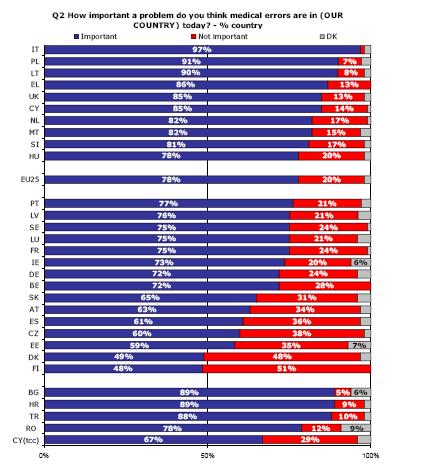
The first survey ever on citizens' perceptions and experiences of medical errors in the EU shows that nearly 80% of Europeans find medical errors an important problem in their country.

A recent Eurobarometer survey on the perception of medical errors by Europeans reveals that almost four in five EU citizens (78%) classify medical errors as an important problem in their country. In Italy (97%), Poland (91%) and Lithuania (90%), the great majority of the respondents evaluated the problem as 'important'. Finland and Denmark clearly stand out from the other countries as their citizens (51% and 48% respectively) do not consider medical errors to be an imminent issue in their country.

According to the survey, most EU citizens trust medical professionals not to make a mistake while treating their patients. Dentists are the most trusted category with 74% of Europeans having confidence in them. However, many respondents doubted the quality of health care provided by other medical professional groups. This, according to the survey results, implied that "trust in the functioning of health care systems could be improved."

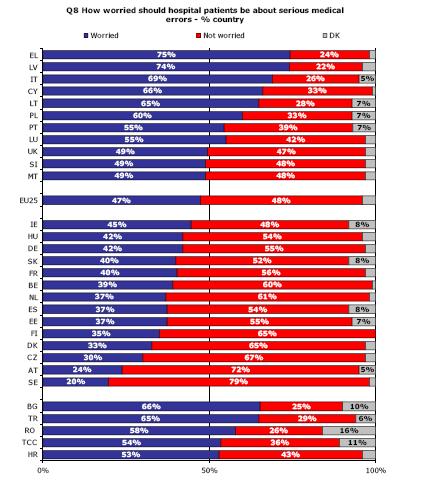
Q8 How worried should hospital patients be about serious medical errors?


48% of the EU citizens state that hospital patients should be worried about the possibility of a serious medical error whereas a very slight majority of 49% says the opposite.

Those living in Greece (75%), Latvia (74%) and Italy (69%) feel the most concerned, 28% of Greeks, 26% of Latvians and 17% of Italians rating as very worried. The highest share of those being very worried is found in Cyprus, the score reaching 31%.
The citizens of Sweden (20%), Austria (24%) and the Czech Republic (30%) remain less concerned.

Even if direct comparison with the question of citizens’ personal level of concern of suffering a serious medical error (Q7) is not reliable here, it can be pointed out that when the respondents are asked how worried a hospital patient should be to suffer a serious medical error, they seem to be more concerned about the possibility of a medical error than when they asked in the personal dimension.

All in all, it can be roughly generalised that citizens of Southern Europe and new Member States around the Baltic Sea appear to be somewhat more concerned of the safety of hospital patients while citizens of Western Europe, in particular of the Nordic Member States, seem to have more confidence in their healthcare system.

The findings of socio-demographic analysis are consistent with the already observed patterns though the tendencies are somewhat weak. Women, those in the two oldest age groups and less educated respondents express slightly more concern than their counterparts while managers and students remain less worried about the issue.

What comes to the cross-tabulation of questions, the same remarks can be made as
with the previous question but the differences are even stronger. A clear majority of those rating the problem as important also expresses concern over the safety of hospital patients and, as expected, this is also the case for those who have personal experiences of medical errors.

The Commission is set to integrate the results of this first analysis into the work of the patient safety working group.

Source

Eurobarometer: Special Eurobarometer on Medical Errors (January 2006) [FR] [DE]

Tuesday, June 20, 2006

Greek-Turkish meeting of Hospital Pharmacists

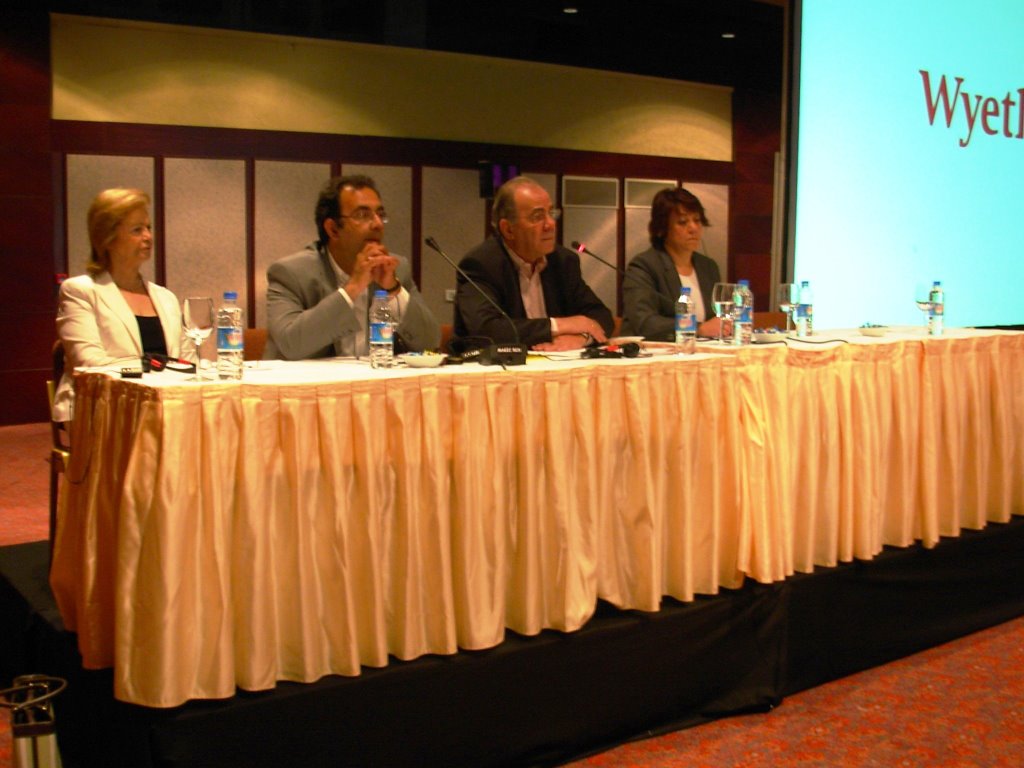
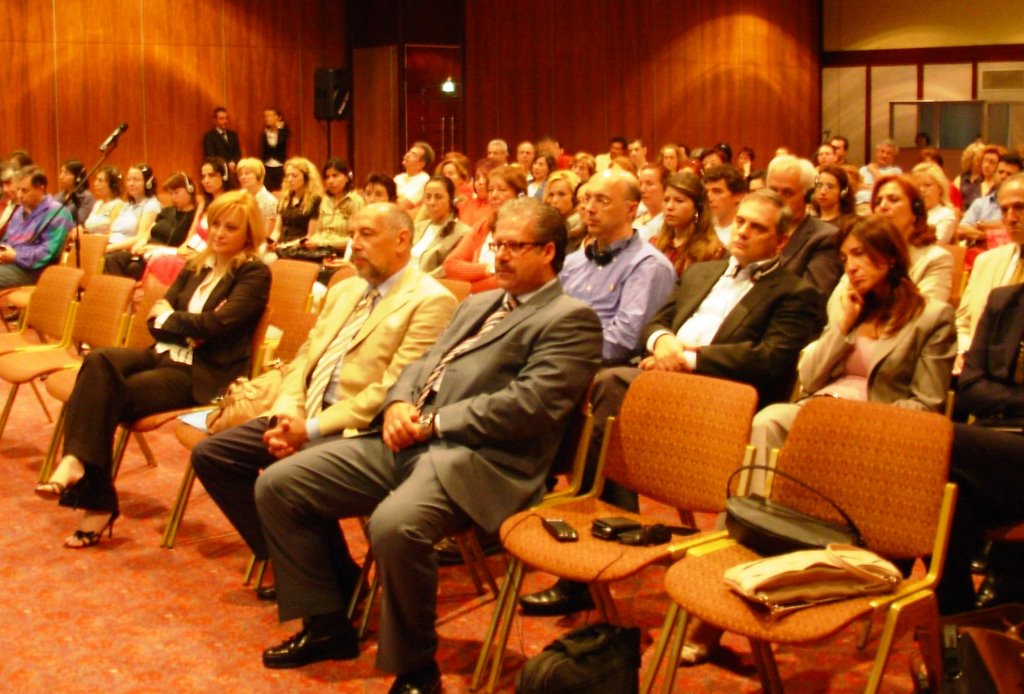
The first ever meeting among Greeks and Turkish Hospital Pharmacists was completed. The Seminar of Hospital Pharmacists organised by PEFNI Society (PanHellenic Society of Hospital Pharmacists), on first time in Greece and Turkey.

The speakers were reported on issues with regard to the antibiotics, the cytotoxics and pharmacoeconomics issues.

The audience constituted from Greeks and Turkish Hospital Pharmacists.


Saturday, June 03, 2006

European Medicines Agency adopts first positive opinion for a medicinal product derived from transgenic biotechnology


London, 2 June 2006
Doc. Ref. EMEA/203163/2006

PRESS RELEASE

European Medicines Agency adopts first positive opinion for a medicinal product
derived from transgenic biotechnology

The European Medicines Agency has adopted the first positive opinion for a medicinal product derived from transgenic biotechnology. ATryn, from Genzyme Europe, contains antithrombin alfa, a recombinant-DNA human anti-clotting blood protein. Antithrombin alfa is extracted from the milk of goats which have the human antithrombin gene inserted, that enables them to produce the human protein in their milk.

The Agency’s Committee for Medicinal Products for Human Use (CHMP) adopted the positive opinion at its meeting of 29 May to 1 June 2006, recommending that ATryn should be authorised for use in patients with congenital antithrombin (AT) deficiency (inherited reduction of antithrombin) undergoing surgery, for the prophylaxis of deep-vein thrombosis (formation of clots in the vessels of the legs) and thromboembolism (formation of clots in other vessels of the body).

In February 2006, ATryn received a negative opinion. At the request of the company, the Committee started a procedure to re-examine its opinion, as part of which further expert advice was obtained.

At the end of this procedure the CHMP concluded that the benefits of ATryn outweigh its risks, and subsequently adopted a final positive opinion recommending that ATryn be granted a marketing authorisation.

Notes

1. A question and answer document with background information is available here.
2. A summary of opinion for ATryn is available here.
3. Congenital antithrombin deficiency is a rare condition that affects about 1 in 3.000 to 5.000 people.
4. The CHMP recommended the granting of a marketing authorisation under exceptional
circumstances for ATryn. Such authorisations are permissible, in accordance with Article 14(8) of Regulation (EC) 726/2004, for medicinal products for which the applicant can demonstrate that comprehensive data cannot be provided, for example because of the rarity of the condition, so long as it can be demonstrated that the benefits outweigh the risks. For more information see the relevant guideline here.
5. This press release, together with other information on the work of the European Medicines Agency, can be found on the EMEA website at: www.emea.eu.int

Links

European Medicines Agency http://www.emea.eu.int/
http://www.emea.eu.int/pdfs/general/direct/pr/20316306en.pdf

GTC Biotherapeutics http://www.gtc-bio.com/news.html

Genzyme Corp http://www.genzyme.com/

Wednesday, May 31, 2006

New EU portal on health launched


The Commission has launched a new Health-EU Portal to answer to the needs of an estimated third of the EU population searching for information on different health issues.

According to the Commission, every third European adult is surfing the internet trying to find information on health. To help these people to find their way around, the Commission has launched, in the context of the eHealth 2006 conference, a new portal on health. The Health-EU Portal aims to be a gateway and 'one-stop-shop' to simple and reliable information on 6 thematic health areas, divided in 47 health topics, touching upon issues from health insurance and infectious diseases to bioterrorism.

The site aims to provide citizens, patients, healthcare professionals and scientists with information on both health topics and related policies as well as on the latest developments in research.

The Health-EU Portal supplies links to all member states' health-related policies and other health issues, to a large number of specialist websites and to sites of NGOs and international organisations.

This 600 000 euro project is an initiative of the EU Public Health Programme 2003-2008 and corresponds also to the aspirations on the e-Europe Action Plan as the portal aims to provide citizens with simple, clear and scientifically sound information on-line.

Links

EU official documents
Commission: Health-EU PortalCommission press release: Reliable health information at the click of a mouse – European Commission launches new Health Portal (10 May 2006) [FR] [DE]